

Note
Go to the end to download the full example code.
Hub skore Project#
This example shows how to use Project in hub mode: store
reports remotely and inspect them. A key point is that
summarize() returns a Summary,
which is a pandas.DataFrame. In Jupyter you get an interactive widget, but
you can always inspect and filter the summary as a DataFrame if you prefer.
Examples#
To run this example and push in your own Skore Hub workspace and project, you can run this example with the following command:
WORKSPACE=<workspace> PROJECT=<project> python plot_skore_hub_project.py
In this gallery, we are going to push the different reports into a public workspace.
from skore import login

login()
╭───────────────────────────────── Login to Skore Hub ─────────────────────────────────╮
│                                                                                      │
│                        Successfully logged in, using API key.                        │
│                                                                                      │
╰──────────────────────────────────────────────────────────────────────────────────────╯
from sklearn.datasets import load_breast_cancer
from sklearn.linear_model import LogisticRegression
from skore import train_test_split
from skrub import tabular_pipeline

X, y = load_breast_cancer(return_X_y=True, as_frame=True)
split_data = train_test_split(X=X, y=y, random_state=42, as_dict=True)
estimator = tabular_pipeline(LogisticRegression(max_iter=1_000))
╭────────────────────── HighClassImbalanceTooFewExamplesWarning ───────────────────────╮
│ It seems that you have a classification problem with at least one class with fewer   │
│ than 100 examples in the test set. In this case, using train_test_split may not be a │
│ good idea because of high variability in the scores obtained on the test set. We     │
│ suggest three options to tackle this challenge: you can increase test_size, collect  │
│ more data, or use skore's CrossValidationReport with the `splitter` parameter of     │
│ your choice.                                                                         │
╰──────────────────────────────────────────────────────────────────────────────────────╯
╭───────────────────────────────── ShuffleTrueWarning ─────────────────────────────────╮
│ We detected that the `shuffle` parameter is set to `True` either explicitly or from  │
│ its default value. In case of time-ordered events (even if they are independent),    │
│ this will result in inflated model performance evaluation because natural drift will │
│ not be taken into account. We recommend setting the shuffle parameter to `False` in  │
│ order to ensure the evaluation process is really representative of your production   │
│ release process.                                                                     │
╰──────────────────────────────────────────────────────────────────────────────────────╯
from numpy import logspace
from sklearn.base import clone
from skore import EstimatorReport, Project

project = Project(f"{WORKSPACE}/{PROJECT}", mode="hub")

for regularization in logspace(-3, 3, 5):
    project.put(
        f"lr-regularization-{regularization:.1e}",
        EstimatorReport(
            clone(estimator).set_params(logisticregression__C=regularization),
            **split_data,
            pos_label=1,
        ),
    )
  Putting lr-regularization-1.0e-03 0:00:39
Consult your report at
https://skore.probabl.ai/skore/example-skore-hub-project-0.13/estimators/70


  Putting lr-regularization-3.2e-02 0:00:38
Consult your report at
https://skore.probabl.ai/skore/example-skore-hub-project-0.13/estimators/71


  Putting lr-regularization-1.0e+00 0:00:39
Consult your report at
https://skore.probabl.ai/skore/example-skore-hub-project-0.13/estimators/72


  Putting lr-regularization-3.2e+01 0:00:37
Consult your report at
https://skore.probabl.ai/skore/example-skore-hub-project-0.13/estimators/73


  Putting lr-regularization-1.0e+03 0:00:38
Consult your report at
https://skore.probabl.ai/skore/example-skore-hub-project-0.13/estimators/74
Summarize: you get a DataFrame#
summarize() returns a Summary,
which subclasses pandas.DataFrame. In a Jupyter environment it renders
an interactive parallel-coordinates widget by default.
summary = project.summarize()
To see the normal DataFrame table instead of the widget (e.g. in scripts or
when you prefer the table), wrap the summary in pandas.DataFrame:
import pandas as pd

pandas_summary = pd.DataFrame(summary)
pandas_summary
Basically, our summary contains metadata related to various information that we need to quickly help filtering the reports.
<class 'skore._project._summary.Summary'>
MultiIndex: 5 entries, (0, 'skore:report:estimator:70') to (4, 'skore:report:estimator:74')
Data columns (total 16 columns):
 #   Column             Non-Null Count  Dtype
---  ------             --------------  -----
 0   key                5 non-null      object
 1   date               5 non-null      object
 2   learner            5 non-null      category
 3   ml_task            5 non-null      object
 4   report_type        5 non-null      object
 5   dataset            5 non-null      object
 6   rmse               0 non-null      object
 7   log_loss           5 non-null      float64
 8   roc_auc            5 non-null      float64
 9   fit_time           5 non-null      float64
 10  predict_time       5 non-null      float64
 11  rmse_mean          0 non-null      object
 12  log_loss_mean      0 non-null      object
 13  roc_auc_mean       0 non-null      object
 14  fit_time_mean      0 non-null      object
 15  predict_time_mean  0 non-null      object
dtypes: category(1), float64(4), object(11)
memory usage: 1.1+ KB
Filter reports by metric (e.g. keep only those above a given accuracy) and work with the result as a table.
summary.query("log_loss < 0.1")["key"].tolist()
['lr-regularization-1.0e+00', 'lr-regularization-3.2e+01']
Use reports() to load the corresponding
reports from the project (optionally after filtering the summary).
reports = summary.query("log_loss < 0.1").reports(return_as="comparison")
len(reports.reports_)
2
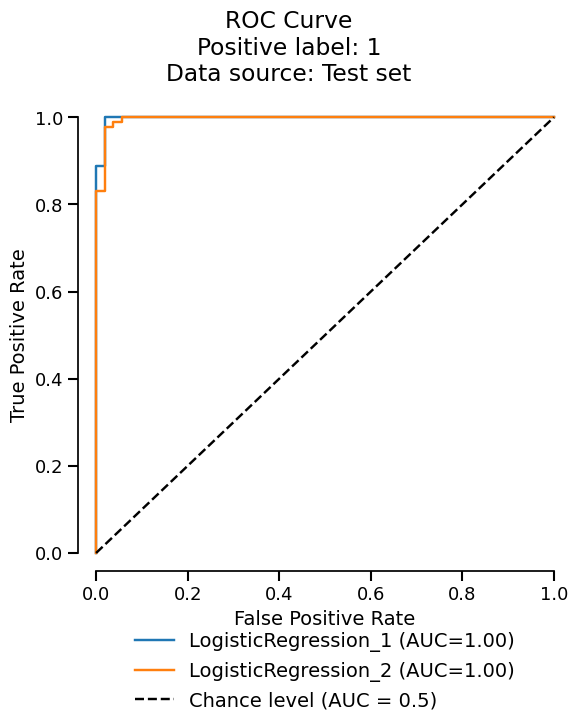
Since we got a ComparisonReport, we can use the metrics accessor
to summarize the metrics across the reports.
reports.metrics.summarize().frame()
reports.metrics.roc().plot(subplot_by=None)
Total running time of the script: (3 minutes 25.144 seconds)