

MetricsSummaryDisplay#
- class skore.MetricsSummaryDisplay(rows, report_type)[source]#
Display for summarize.
An instance of this class will be created by
Report.metrics.summarize(). This class should not be instantiated directly.- Parameters:
- rowslist of dicts
The rows to display. Expected keys: - “metric”: human-readable metric name shown in the display. - “estimator_name” - “data_source”: “train” or “test”. - “score”: numeric metric value (scalar). - “favorability”: “(↗︎)”, “(↘︎)” or “”.
Depending on the metric shape and report type, rows may also contain: - “label”: class label for per-class classification metrics. - “output”: output index for multioutput regression metrics. - “average”: averaging mode when averaged over labels or outputs. - “split”: cross-validation split index.
- report_type{“estimator”, “comparison-estimator”, “cross-validation”, “comparison-cross-validation”}
The type of report.
- frame(*, aggregate=('mean', 'std'), favorability=False, flat_index=False)[source]#
Return the summarize as a dataframe.
- Parameters:
- aggregate{“mean”, “std”}, list of such str or None, default=(“mean”, “std”)
Only used when
report_typeincludes"cross-validation". Functions to aggregate the scores across the cross-validation splits. None will return the scores for each split.- favorabilitybool, default=False
Whether or not to add an indicator of the favorability of the metric as an extra column in the returned DataFrame.
- flat_indexbool, default=False
Whether to return a flat index or a multi-index.
- Returns:
- framepandas.DataFrame
The report metrics as a dataframe.
- set_style(*, policy='update', **kwargs)[source]#
Set the style parameters for the display.
- Parameters:
- policyLiteral[“override”, “update”], default=”update”
Policy to use when setting the style parameters. If “override”, existing settings are set to the provided values. If “update”, existing settings are not changed; only settings that were previously unset are changed.
- **kwargsdict
Style parameters to set. Each parameter name should correspond to a a style attribute passed to the plot method of the display.
- Returns:
- None
- Raises:
- ValueError
If a style parameter is unknown.
- static style_plot(plot_func)[source]#
Apply consistent style to skore displays.
This decorator: 1. Applies default style settings 2. Runs
plot_funcunderplt.ioff()so figures are not shown until returned 3. CallsFigure.tight_layout()on the returned figure when applicable 4. Deregisters pyplot-managed figures created during the display call 5. Restores the original style settings- Parameters:
- plot_funccallable
The plot function to be decorated.
- Returns:
- callable
The decorated plot function.
Gallery examples#

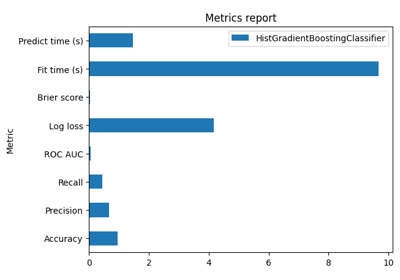
EstimatorReport: Get insights from any scikit-learn estimator